

 View larger
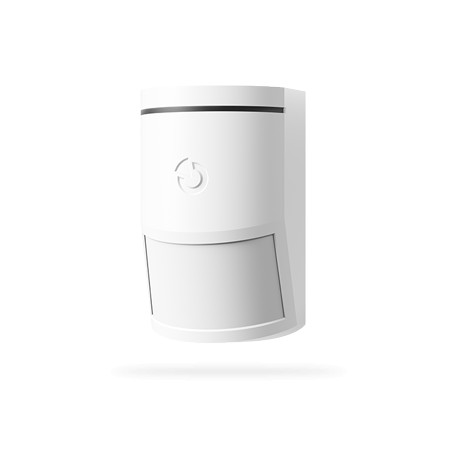
JAB Wireless dual PIR & MW motion detector JA-161PW
More info
JA-161PW is a wireless combined motion detector (PIR + microwave) designed for reliable indoor intrusion detection. The dual-sensor concept uses PIR detection with microwave confirmation to reduce false alarms caused by sudden temperature changes, drafts or heat sources.
The detector is addressable within the JABLOTRON 100+ system and supports two‑way wireless communication on 868.1 MHz (JABLOTRON protocol). Mechanical design follows the JABLOTRON 100+ motion detector family. Configuration and sensitivity adjustments can be performed remotely (F-Link); microwave sensitivity is adjustable in four levels.
Key technical data:
- Detection coverage (PIR): 110° / up to 12 m.
- Detection coverage (MW): 90° / up to 12 m; MW operating frequency 24.125 GHz, maximum MW EIRP 50 mW.
- Wireless link: 868.1 MHz, maximum RF power (ERP) <25 mW.
- Power supply: 2× alkaline LR6 (AA) 1.5 V / 2.45 Ah; typical battery life ≈ 2 years.
- Recommended installation height: 2.5 m.
- Dimensions: 60 × 98 × 52 mm; weight (without batteries): 93 g.
- Classification: security grade 2 / environmental class II.
In addition to intrusion detection, the JA-161PW can be used for automation tasks such as automatic lighting. The microwave sensor may be disabled when the system is disarmed so the detector responds only to PIR for faster automation. Installation should be carried out by a trained technician and the guarded area checked carefully to ensure full coverage.
Regulatory note: check local regulations for microwave device use. Some countries restrict use in specific 24 GHz sub-bands (e.g. limitations may apply in certain jurisdictions).